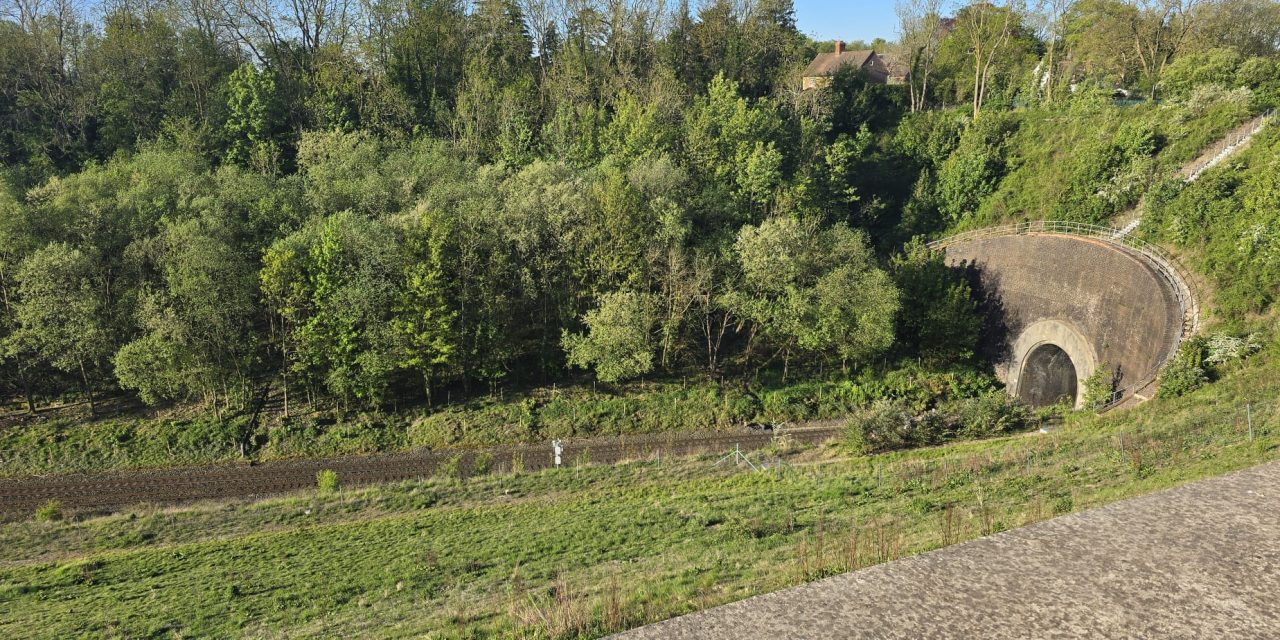
Network Rail manages approximately 190,000 earthwork sites in the UK. Although most passengers will never see these assets, comprising embankments, soil cuttings and rock cuttings, the network’s safety and service provision rely on their effective management.

The issue has grown in importance, as the UK’s increasingly milder and wetter winters drive soil changes that increase landslip risk. Periodic manual surveys have been used to record earthwork changes but cannot detect sudden ground movement, which could cause disruption, safety incidents and service delays.
A smarter approach to slope monitoring
DYWIDAG’s Smart Guard, powered by Worldsensing, was developed to address earthwork risk. It is designed for challenging rail environments and goes far beyond conventional embankment and slope monitoring by combining four crucial elements in a single system:
- Rapid event detection
- Resilient communications
- Automated image capture
- An Infrastructure Intelligence visualisation platform
The platform turns complex monitoring data into clear situational awareness. Smart Guard’s dashboard brings together configurable widgets, maps, camera feeds and alert summaries, and highlights alarms, sensor health and recent activity. These features enable teams to make quicker, more confident operational decisions.
Smart Guard’s speed is the headline. The system detects tilt movement in under five seconds and delivers an operational alert within six seconds. When a slope is starting to fail, those seconds matter.

Additionally, Smart Guard continues to function effectively where failures are most likely: in severe weather, dense vegetation and saturated ground. It uses 868 MHz LoRa communication between sensors and gateways, which delivers critical alerts through wet foliage and uneven terrain.
Proof in practice: Harbury Cutting
Harbury Cutting in Warwickshire provides a live example of Smart Guard in an operational rail environment. The heavily forested 180m slope is exposed to harsh weather and has a reputation for instability and ground movement. Network Rail required a continuous monitoring system that could cope with the known instability, dense vegetation and challenging environmental conditions, and raise the alarm in the event of landslip.

Smart Guard was chosen for its event detection and signal speed. For the project, DYWIDAG supplied and installed:
- 83 tilt sensors
- 6 cameras
The equipment was sited using driven sensor posts and rope-access installation. This avoided excavation and helped preserve the in-situ ground conditions. Rope access technicians were also required for difficult-to-reach areas, eliminating the need for heavy machinery such as scaffolding and cranes.
Once installed, the Smart Guard system linked to the Infrastructure Intelligence cloud-based platform. This connected to Network Rail’s RADAR system to support improved visibility, faster engineering assessment and proactive risk management.

A new standard for rail monitoring
Harbury Cutting demonstrates how Smart Guard works in a live rail environment, not only in theory. Its resilience supports continued monitoring in challenging environmental conditions, subject to technical confirmation. Its detection and alerting speed provide engineers with faster access to information to support assessment when potential movement is detected.
For an industry responsible for thousands of safety-critical slopes, wider adoption of technology, such as Smart Guard, supports proactive risk management and rapid decision-making.