
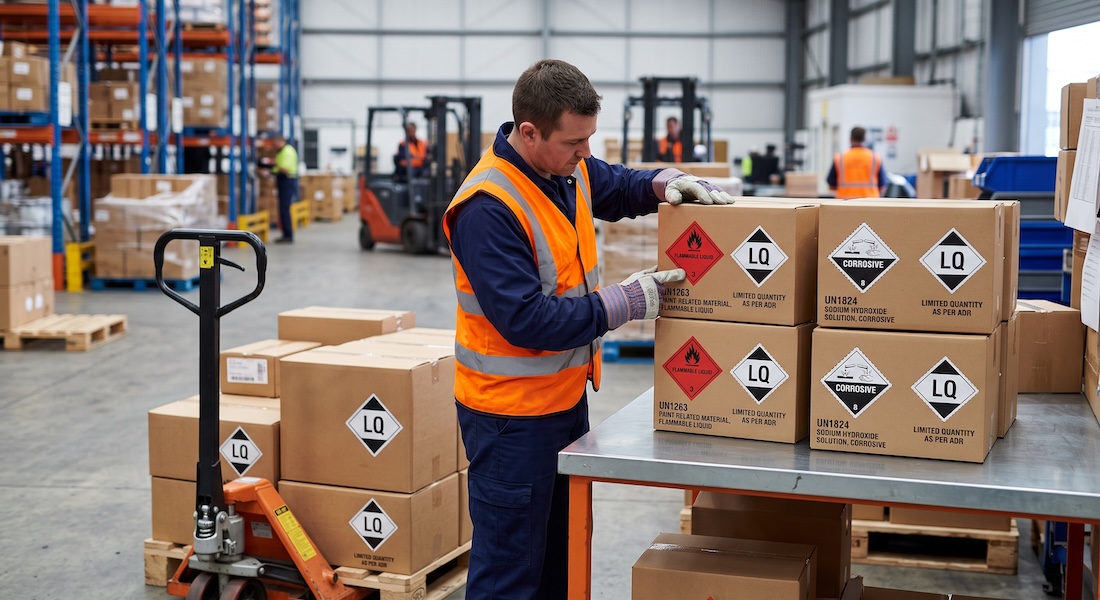
The loading bay is a poor place to start working out whether a chemical shipment has been prepared correctly.
By collection time, the product should already have been identified, classified and packed. The correct marks should be on the package and the carrier should know what it has been asked to move.
For Class 3 flammable liquids and Class 8 corrosives, that preparation often involves the Limited Quantity provisions under ADR.
Limited Quantity can reduce some of the requirements attached to dangerous-goods transport, but it does not turn dangerous goods into ordinary freight.
Know what the product actually is
The current Safety Data Sheet is usually the first useful document.
Section 14 provides transport information such as the UN number, Proper Shipping Name, class and, where applicable, Packing Group.
It is a starting point rather than the final decision.
The consignor remains responsible for correctly identifying and classifying the dangerous goods, and the relevant ADR entry determines whether the product can be transported under the Limited Quantity provisions.
That distinction matters because there is no standard “LQ bottle size”.
Two products in the same hazard class can have different permitted inner quantities. Some dangerous-goods entries allow several litres per inner receptacle, others much less, and some do not offer a Limited Quantity provision at all.
The warehouse therefore needs to check the exact entry for the product being dispatched rather than work from a general rule picked up from another shipment.
Check both the bottle and the finished package
Limited Quantity rules do not stop at the inner receptacle.
The completed outer package has limits as well.
Under ADR, a standard Limited Quantity package must not exceed 30 kg gross mass. Where shrink-wrapped or stretch-wrapped trays are permitted, the maximum gross mass is 20 kg.
That means individually compliant bottles can still end up forming a package that cannot travel under the LQ provisions as packed.
“Limited Quantity sometimes gets interpreted as ‘the carrier doesn’t really need to know about it’, and that’s where problems start,” says George Wicks-Farr, Head of Operations at Pallet2Ship. “The goods are still dangerous goods. If the package, quantity or declaration doesn’t fit the rules or the carrier’s acceptance policy, it is far better to find that out at the packing bench than after the collection has been arranged.”
If an outer package exceeds the permitted LQ limit, that does not mean the chemical suddenly becomes illegal to transport. It means the shipment cannot rely on the Limited Quantity provisions in that configuration. It may need repacking or preparation under the full dangerous-goods requirements instead.
A practical dangerous goods guide can help warehouse teams turn those regulatory checks into a repeatable packing and dispatch process.
The outside of the package matters
Correct marking is part of the preparation.
Qualifying ADR Limited Quantity packages use the prescribed LQ diamond mark.
Orientation arrows are required in the circumstances specified by ADR for certain packages containing liquids, rather than being an automatic requirement for every liquid LQ package.
Absorbent material is similar. It should be used where the applicable packing provisions call for it, not simply added as a blanket rule to every Class 3 or Class 8 shipment.
The package itself still needs to be suitable for transport. Limited Quantity provisions remove some requirements; they do not make weak or inappropriate packaging acceptable.
Tell the carrier what is moving
Another common misunderstanding is that LQ status means there is nothing to declare.
Carrier acceptance still applies.
Networks differ in what they will carry, the services they allow dangerous goods onto and the routes they support. A shipment that satisfies the regulatory LQ provisions may still fall outside a particular carrier’s operational acceptance rules.
The carrier therefore needs accurate information before collection is booked.
That is also why responsibilities cannot be reduced to a simple “shipper versus driver” split. ADR places duties on several parties, including consignors, packers, loaders, carriers and drivers. Classification and packaging problems should have been resolved before the driver reaches the premises.
Don’t assume the road rules cover the whole journey
A shipment leaving a UK warehouse by road may subsequently travel by sea.
At that point the IMDG Code becomes relevant as well.
ADR and IMDG share a number of concepts, but the requirements are not identical and compliance with the road leg should not be treated as automatic compliance with every later mode.
A sensible final check therefore asks four questions:
Has the product been classified correctly? Does the package qualify for the LQ treatment being used? Are the packaging and marks correct? And has the actual product and route been accepted by the carrier?
If all four answers are clear before the vehicle arrives, the loading bay stays what it should be: the point where a prepared shipment is handed over, not where its compliance is first investigated.